 Edward Bellamy House
The sequel to Looking Backward was a bestseller when it was published, but it is generally forgotten today. In this blog post, we look at how it differed from the earlier novel and why it didn’t become an enduring classic.

According to Edward Bellamy’s daughter, he wrote Equality at this desk.
Edward Bellamy published Equality, the sequel to Looking Backward, in 1897, nine years after the first book about Julian West’s experiences in the year 2000 came out. In the time between the two publications, he had started—and ended—publication of a weekly newspaper, given talks to various audiences, and generally become more politically outspoken. However, he didn’t feel that these activities allowed him to adequately respond to the criticism of the ideas presented in Looking Backward, and he believed that there was so much more to say than he had been able to in that book. So, in 1893, he began writing Equality.1
At first, he tried writing a completely different novel that would echo and expand upon the themes of his most successful work. Eventually, though, he returned to the familiar characters of Julian West and Dr. Leete. Not wanting to distract from his goal of explaining his ideas in greater detail, he instead decided to abandon any attempt at a plot. Each chapter functions like an essay on a specific topic, expanding on themes such as inequality of wealth, women’s rights, and the structure of society but leaving little room for the romance that was a part of Looking Backward. Bellamy also relied on repetition, repeating not just the themes of the earlier novel but ideas and phrases from past speeches and articles as well.2
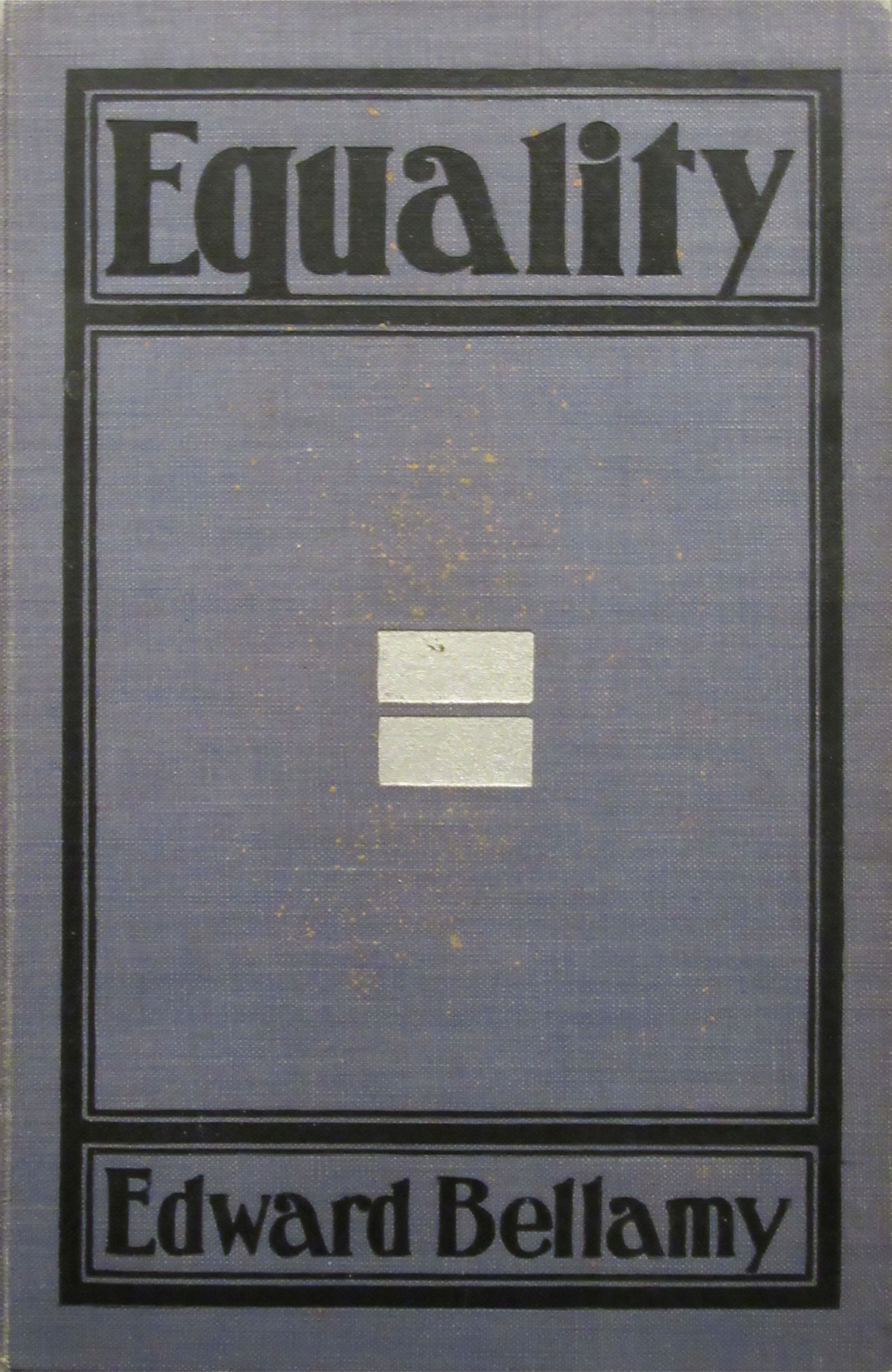 The repetition that Bellamy thought emphasized the importance of his ideas was “tedious” to one reviewer, who wrote that “To one acquainted with Socialistic literature, there is nothing in its principles that is new.” Likewise, the review in the Critic warned readers, “It is plotless and of no calculable worth as a novel, although it is written with great care and extraordinary clearness.” However, Bellamy thought that Equality was the best book he had written, and readers were eager to acquire it3; within the first six months of publication, 21,044 copies had been sold. According to the New York Times, “It took precisely thirty-six hours for every copy of ‘Equality,’ […] to be cleared off the shelves of the Messrs. D. Appleton & Co. of New York.” Reviewers such as the author of the review in the literary magazine Overland Monthly acknowledged that “[t]he book is well written,” and believed that it was “sure to be widely read and discussed.”4
Looking Backward was so popular that it was impossible for its sequel to go unnoticed. In the end, what prevented Equality from claiming a spot among the classics was its distinct lack of literary style. Casual readers weren’t looking for a collection of essays on the shortcomings of capitalism; they just wanted a well-told story. Unfortunately, Bellamy didn’t get another chance at writing a novel, dying of tuberculosis less than a year after Equality’s publication.
Notes
- Sylvia Bowman, The Year 2000 (New York: Bookman Associates, 1958), 138-9.
- Bowman, 132, 139-40.
- The first edition of Equality was priced at $1.25. “Book Reviews,” Overland Monthly, November, 1897, 472.
- “Fact and Fiction in Social Study,” Dial, July 16, 1897, 49; “Equality,” Critic, July 10, 1897, 19; Bowman, 140-1; “Books and Authors,” New York Times, July 7, 1897; “Book Reviews,” 472.
 Edward Bellamy House